Every local SEO agency has the same problem.
You know your service works. You know the client needs it. But the moment you start talking about "map pack rankings" and "citation consistency," their eyes glaze over. The meeting ends with "we'll think about it." The follow-up email goes unanswered. The deal dies.
It's not because local SEO doesn't work. It's because most agencies sell it wrong.
They sell the process. They should be selling the gap.
In this guide, we'll break down how top-performing agencies are closing local SEO clients faster — not by polishing their pitch decks, but by walking into meetings with data the prospect can't ignore.
Why Traditional Local SEO Pitches Fail
The typical agency sales meeting looks something like this: you pull up a slide deck, explain how Google's local algorithm works, show a few before-and-after ranking screenshots from past clients, and hope the prospect connects the dots.
Here's the problem: business owners don't think in keywords and rankings. They think in phone calls, booked jobs, and revenue.
When you say "we'll get you into the local 3-pack," they hear noise. When you say "you're losing an estimated 48 calls per month to competitors who rank above you — that's roughly $45,000 in missed revenue," they hear a problem they need solved immediately.
The agencies that close at 40–60% aren't better at SEO. They're better at translating SEO into dollars.
The Data-First Sales Framework
The shift is simple: instead of telling prospects what you do, show them what they're losing.
This requires flipping the traditional sales process. Before you ever get on a call, you run a scan on the prospect's business and build a one-page report that answers three questions:
- Where are they visible? A geographic heatmap showing where they rank across a grid of search locations around their service area.
- Where are they invisible? The red zones — areas where customers are searching but the business doesn't appear.
- What is that costing them? An estimated revenue gap based on search volume, average job value, and missed calls.
When you walk into a meeting with this data, you're not pitching. You're diagnosing. And that changes everything about how the conversation goes.
Step 1: Run a Prospect Scan Before the Meeting
The best agencies never walk into a sales meeting cold. They scan the prospect's Google Business Profile before the first conversation happens.
A prospect scan pulls live ranking data across a grid of geographic points around the business. Instead of checking whether they rank for one keyword in one location, you're mapping their visibility across their entire service area.
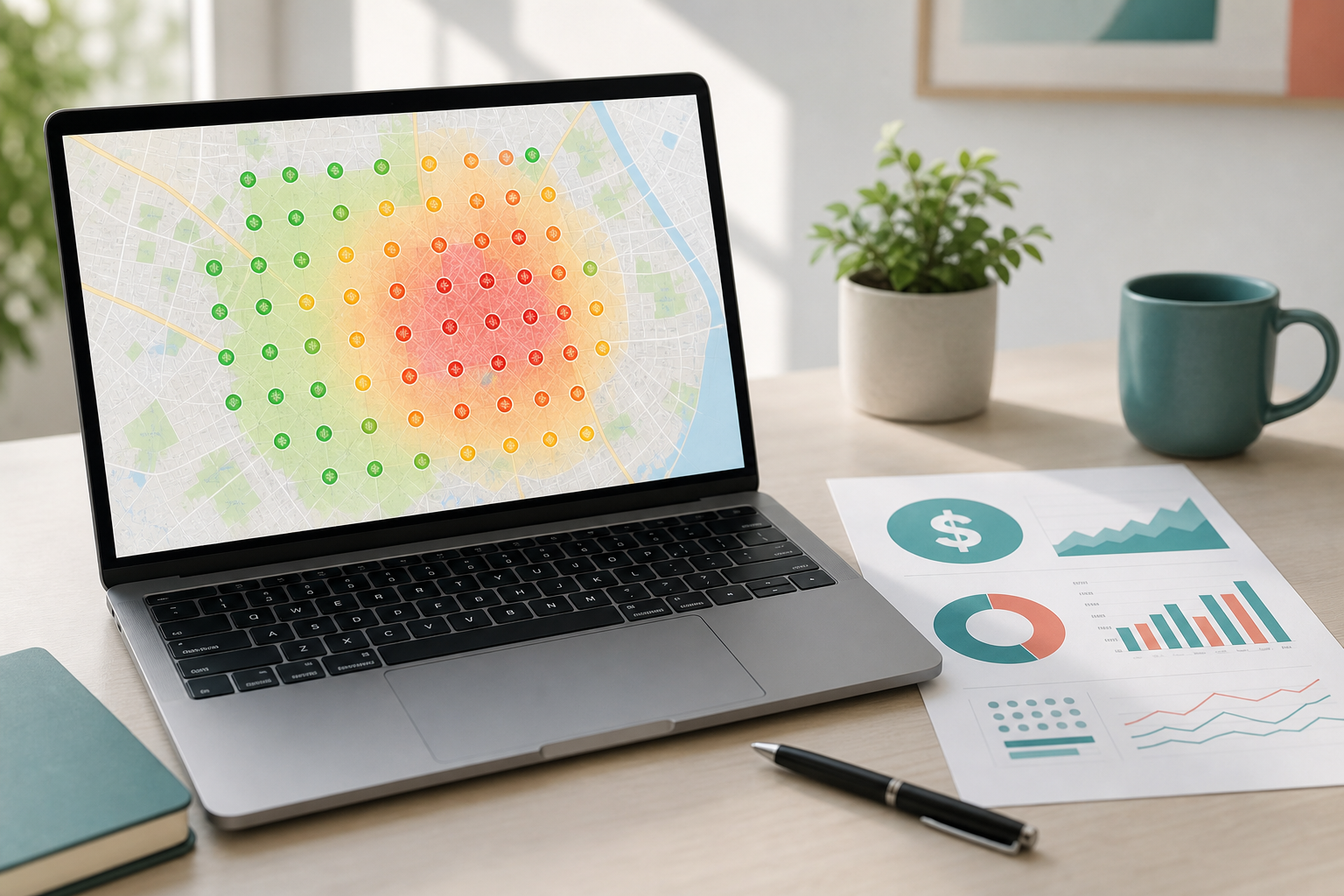
The output is a heatmap grid — a color-coded visual showing green where the business ranks well and red where they're invisible. Most business owners have never seen their visibility laid out this way, and the reaction is almost always the same: "I had no idea we weren't showing up there."
This isn't theoretical. A 2026 study by BrightLocal found that 98% of consumers used the internet to find information about local businesses, and 87% used Google specifically. If a business isn't visible across its service area, it's not a minor issue — it's a revenue leak.
The scan takes about 60 seconds. The impact on your close rate is permanent.
Step 2: Quantify the Revenue Gap
A heatmap shows the problem. The revenue gap makes it urgent.
Here's the framework top agencies use to translate rankings into dollars:
- Estimated monthly searches for the prospect's core services in their area
- Average click-through rate for map pack positions (position 1 gets roughly 25–30% of clicks; positions 4+ get almost nothing)
- Call-to-lead conversion rate for local service businesses (typically 30–50%)
- Average job value for the prospect's industry
Run those numbers and you get a clear picture: "Based on your current visibility, you're missing approximately X calls per month. At your average job value of $Y, that's $Z in revenue your competitors are capturing instead."
For a plumber ranking poorly across a mid-size metro area, that number might be $30,000–$50,000 per month. For a personal injury attorney, it could be multiples of that.
Business owners understand money. They might not understand local SEO, but they absolutely understand that $40,000 per month is walking out their door.
Step 3: Show Them the Competitor Landscape
Revenue gap data creates urgency. Competitor data creates fear of missing out.
Your prospect scan should include at least a basic view of who is ranking where they aren't. When a business owner sees that three competitors dominate the areas they're invisible in, the question shifts from "should we invest in SEO?" to "how fast can we start?"
Here's what to highlight:
- Which competitors rank in the prospect's weak zones. Name them. Business owners know their competitors by name, and seeing "Joe's Plumbing ranks #1 in 14 of the 49 grid points where you don't appear at all" is far more visceral than any chart.
- Review count and rating gaps. If a competitor has 340 reviews at 4.8 stars and your prospect has 47 reviews at 4.2 stars, that's a tangible gap to point to.
- GBP completeness. Competitors with fully optimized profiles — photos, services, Q&A, weekly posts — will consistently outperform incomplete ones. Show the prospect exactly where their profile falls short.
This isn't about scaring the prospect. It's about giving them an accurate picture of their competitive position. The data does the convincing — you just present it.
Step 4: Deliver the Report, Not a Pitch Deck
The medium matters. A 30-slide deck says "I'm trying to sell you something." A one-page visual report says "I already did the work."
The most effective agencies deliver a single shareable report that includes:
- The heatmap grid with the prospect's visibility mapped
- A GAP score summarizing overall visibility health
- The estimated revenue opportunity
- Top competitor positions
- 3–5 specific recommendations
This report should be white-labeled to your agency and designed to be a leave-behind. Business owners share it with partners. They pin it to their office wall. They forward it to their spouse with "look at this."
The report itself becomes your best salesperson — it keeps working the deal even after you leave the room.
Step 5: Price Against the Gap, Not Against Competitors
One of the biggest mistakes agencies make is pricing their services in a vacuum. When a prospect hears "$500 per month for local SEO," they mentally compare it to their other marketing expenses and often conclude it's too much.
But when they've just seen data showing they're losing $40,000 per month in missed revenue, suddenly $500 feels like a rounding error.
Frame your pricing conversation around the gap:
"Based on the scan, you're currently missing about $38,000 per month in potential revenue. Our service runs $599 per month. Even if we only close half that gap, you're looking at a 30x return."
This isn't sleight of hand. It's context. And it's why agencies using data-driven prospect reports consistently report higher close rates and higher average contract values.
Mistakes That Kill the Data-Driven Close
Even with great data in hand, agencies still fumble the execution. Here are the most common mistakes to avoid:
Burying the lead. Don't spend the first 15 minutes on introductions and company background. Open with the heatmap. Put the data on screen within the first 60 seconds. The report is your opening act, not your encore.
Overexplaining the methodology. Business owners don't care how the grid scan works or what API pulls the ranking data. They care about the red zones and the dollar figure. If they ask how it works, keep it to one sentence: "We check your Google visibility from dozens of locations across your service area to see exactly where customers can and can't find you."
Presenting without a printed leave-behind. Digital is fine for follow-up, but in-person meetings benefit enormously from a physical, printed report. It sits on the prospect's desk. It gets shown to business partners. It survives inbox clutter.
Scanning only one keyword. A plumber doesn't just need to rank for "plumber near me." They need visibility for emergency plumbing, drain cleaning, water heater repair, and a dozen other services. Run scans across multiple core service keywords to show the full scope of the gap.
Forgetting to follow up with data updates. If the prospect doesn't close immediately, send a follow-up scan 2–4 weeks later. Rankings shift. Competitors move. A fresh scan with "here's what changed since we last spoke" re-engages the conversation with zero pressure and new urgency.
What Changes When You Lead With Data
Agencies that adopt this approach typically see three shifts:
- Shorter sales cycles. When the prospect can see the problem and quantify the cost, there's less deliberation. Many agencies report closing in the first meeting instead of the third or fourth.
- Higher close rates. Industry averages for local SEO sales hover around 15–25%. Agencies using prospect scan reports regularly report rates of 40–60%. The data removes the biggest objection — "I'm not sure this will work for us" — before it's ever raised.
- Less price resistance. When the conversation anchors on a $40,000 monthly revenue gap, a $500 monthly retainer doesn't trigger sticker shock. Agencies report fewer pricing objections and higher contract values.
The Bottom Line
The agencies winning in 2026 aren't the ones with the best pitch decks or the smoothest sales scripts. They're the ones who show up with data.
A 60-second prospect scan. A visual heatmap. A dollar amount the prospect can't ignore. That's the entire pitch.
Stop explaining what local SEO is. Start showing what it costs to not have it.
Your prospects don't need a lecture. They need a mirror — one that shows them exactly where they're invisible and exactly what that invisibility is costing them every single month.
The data closes the deal. You just have to bring it.
Mapifyer lets you scan any local business in 60 seconds and generate a white-label prospect report showing their visibility gaps, revenue opportunity, and competitor landscape — no GBP access required. Start your first scan →
Frequently Asked Questions
What is a prospect scan in local SEO sales?
A prospect scan is a live ranking audit you run on a potential client's Google Business Profile before your sales meeting. It pulls ranking data across a grid of geographic points around the business, producing a color-coded heatmap that shows exactly where the business appears (and doesn't appear) in local search results. Showing this data up front replaces the traditional pitch deck with hard evidence the prospect can immediately understand.
How do agencies calculate the revenue gap for a prospect?
The revenue gap estimate combines four inputs: (1) estimated monthly search volume for the prospect's core services in their area, (2) the average click-through rate for map pack positions (position 1 captures roughly 25–30% of clicks), (3) the typical call-to-lead conversion rate for that industry (usually 30–50%), and (4) the prospect's average job or customer value. Multiplying these together gives a monthly revenue figure the prospect is likely losing to higher-ranking competitors.
Why do data-driven sales presentations close at higher rates?
Data-driven presentations remove the two biggest objections in local SEO sales: 'I'm not sure this will work for me' and 'it seems expensive.' A heatmap showing specific invisible zones makes the problem concrete and undeniable. Pairing that with a dollar estimate of lost revenue reframes the pricing conversation — a $599/month retainer feels trivial when the prospect can see they're losing $40,000/month in missed business.
How many keywords should I scan when prospecting?
Scan at least 3–5 core service keywords per prospect, not just their primary one. A plumber needs visibility for 'emergency plumber,' 'drain cleaning,' 'water heater repair,' and other high-intent searches — not just 'plumber near me.' Running multiple scans shows the full scope of their visibility gap and makes the revenue estimate more defensible and compelling.
What should a prospect report include?
An effective prospect report includes: the heatmap grid showing ranking positions across the service area, an overall GAP or visibility score, the estimated monthly revenue opportunity, top competitor rankings in the client's weak zones, and 3–5 specific recommendations. It should be white-labeled to your agency and concise enough to leave behind — one page is ideal. The goal is a document the prospect will share with their business partner or reference during their decision process.
How do I follow up if a prospect doesn't close immediately?
Run a fresh prospect scan 2–4 weeks after the initial meeting and send it as a follow-up. Rankings shift and competitors move, so a new scan creates a reason to re-engage that feels helpful rather than pushy. You can frame it as: 'Wanted to follow up with an updated scan — a few things changed in your area since we last spoke.' This approach re-opens the conversation with new urgency without requiring a hard sales ask.